Understanding the Regional Housing Challenge
Housing shortages continue to affect communities across New York State, and the challenges are especially visible in Assembly District 102, which spans Delaware, Greene, Otsego, Schoharie, and parts of Albany County. We talked with Janet Tweed, the Democratic candidate for the district, to discuss the complexities of housing in rural regions and the strategies she believes can help strengthen local housing stock.
Affordability as a Fundamental Need
Tweed emphasizes that affordable housing is not simply a policy preference but a fundamental need for New Yorkers. In her view, improving the housing stock in District 102 requires coordinated work among state and local governments, private developers, and nonprofit organizations. The obstacles are significant: high construction and materials costs, limited return on investment for builders, and development restrictions in areas located within the NYC Watershed all shape what is possible.
She notes that affordability must be understood as a percentage of household income, not a fixed number. Many families in the region—including low-income households and seniors—struggle to find housing that fits their budgets and meets their needs. The shortage of accessible senior housing, in particular, leaves older residents with few options to age safely in place.
The Promise of Accessory Dwelling Units (ADUs)
One of Tweed’s central focus areas is the expansion of Accessory Dwelling Units (ADUs). These small, independent secondary homes—such as backyard cottages, or in-law apartments—offer flexible ways to increase housing without altering the character of rural communities. ADUs can provide homeowners with rental income, create private living space for aging parents or adult children, and often increase overall property value.
New York State already supports ADU development through the Plus One ADU Program. The program offers construction grants to low and middle income homeowners to build or upgrade legal ADUs, with priority given to units rented below market rate. Tweed believes the program is promising but needs modernization: clearer guidelines, updated local codes, and streamlined approval processes without additional fees for municipalities.
Expanding Housing Through Modular Solutions
Beyond ADUs, she points to the potential of modular and prefabricated housing as a way to quickly expand the housing supply. With appropriate state funding and grants, these options could help rural communities add homes efficiently while maintaining environmental safeguards. Green building standards, she notes, must remain central to any expansion to protect the region’s natural resources.
A Path Forward
Housing in District 102 is a challenge, shaped by geography, economics, and community identity. Tweed’s perspective highlights the need for practical, collaborative solutions that respect rural landscapes while addressing the urgent need for more homes.
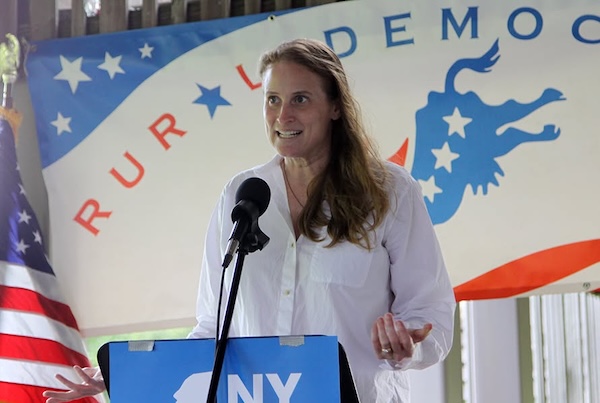
This article was featured in the September 2, 2026 issue of dcDIGEST. Photo of Janet Tweed at the Soapbox Social in Margaretville by Dan Flanagan.