
The following article was featured in the July 7, 2026 issue of dcDIGEST. If you subscribe, check you email inbox for 10am. If you aren’t a subscriber yet, see the link at the bottom of this article.
The National Republican Campaign Committee has already released ads targeting Josh Riley. As in 2024, the balance of power in Congress hangs on NY-19 and a handful of other tight-margin districts across the country. Getting Riley elected is a big responsibility to shoulder, but we’re lucky; we can impact not only our county’s future, but our country’s future.
To win this race—and our state and local races—is no small feat. But new approaches to voter outreach can help tip the scales.
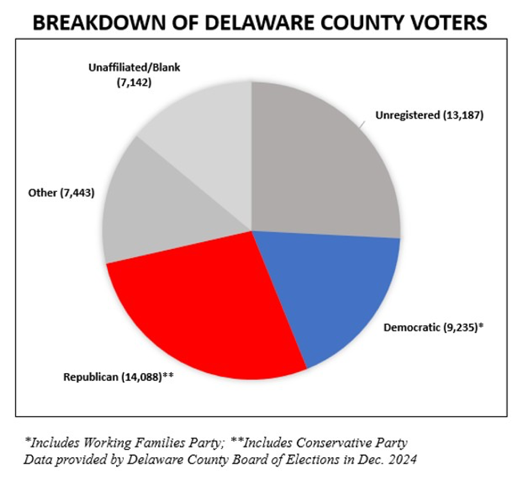
County-level voter statistics don’t directly align with either the Congressional or state district maps, but Delaware County numbers show the tough truth: the Democratic vote alone won’t cut it, even if every single Democrat turns out. Some disaffected Trump voters might stay home, but we can’t bet on Republican apathy; we must secure the votes of some independents (“unaffiliateds”), motivate infrequent voters, register new Dems—and hopefully even convince a slice of former Trump voters to reconsider the Democratic Party.
Traditional voter outreach is precision-oriented; shortly before the election, we try to convince people to vote for specific candidates, focusing on those most likely to vote Democratic. While efficient and effective enough in solidly blue areas, this leaves behind too many voters in “swing” or Republican-leaning areas.
Some Democrats recognize that we’re missing an opportunity to win back communities that have shifted Republican in recent years. Listening-based methods have emerged for learning more about the electorate, increasing voter participation, and ultimately changing hearts and minds.
The idea is to start early, knock on a much wider range of doors, and engage in values-based conversations that emphasize listening and personal story-telling, rather than trying to convince people of the merits of your particular candidate. When personal connections are established, it’s easier to get past defenses, exchange views, and start solving problems together. As one canvasser described an interaction, “Suddenly we were talking about conclusions from the evidence of our lives, not from all of that misinformation, all of those debates and arguments we’re asked to have every day.”
Whether or not you like knocking on doors, the principles of deep canvassing can help all of us draw in voters across party lines – whether talking to family, friends and neighbors, or participating in formal voter outreach programs. None of us wants every future election to feel like a desperate, thin-margin battle. It’s exhausting!
It doesn’t happen overnight, but a new approach can change election outcomes in the short term and build a base for the long-term change to our political discourse we so desperately need.
To explore more, check out Swing Left’s Ground Truth, or the work of Changing the Conversation Together and Down Home North Carolina.
Locally, Western Catskills Indivisible which is using a similar approach tabling at farmer’s markets, town fairs and festivals, and other community events.
To volunteer or find out more, contact WCI directly or drop us a line at newsletter@dcnydems.org