For many voters in our region, environmental and climate change issues are top of mind. As of April 2026, the long-beleaguered Constitution Pipeline is involved in renewed legal and regulatory battles between the developer, Williams Companies, and the NYS Department of Environmental Conservation (DEC).
Although the project was canceled in 2020 because the developer failed to get necessary NYS permits for water quality along the pipeline route, it has been revived with support from the Trump administration. Under the leadership of Trump’s EPA Administrator, Lee Zeldin, the EPA is considering narrowing the scope of the Clean Water Act, which has been used for decades to restrict and monitor energy projects that could adversely affect waterways, wetlands, and land use. This project is slated to cross over 250 bodies of water, many in the western Catskills that are already protected by the DEC.
Although the pipeline received approval from the Federal Energy Regulatory Commission (FERC) in 2014, it was never able to secure the necessary permits from NYS. Now, in an attempt to bypass New York’s oversight authority, Williams Companies is petitioning FERC to reissue the certificate of approval to proceed with construction of the pipeline.
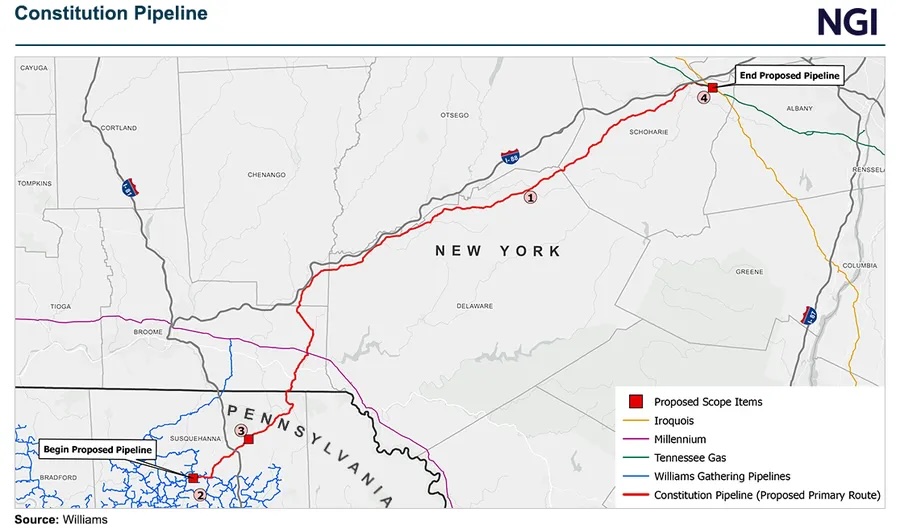
The Constitution Pipeline, if allowed to move forward, would involve the construction of approximately 125 miles of a new interstate natural gas pipeline that would originate in the shale fields of northeastern Pennsylvania with approximately 99 miles running through Broome, Chenango, Delaware, and Schoharie Counties in New York, before reaching its connection point with other existing pipelines in Schoharie County. This would mean the clearing of thousands of acres or trees, and the threatening of critical habitats.
The opposition to this pipeline has been loud and clear, including state regulators and environmental groups. The New York DEC and the State Attorney General have filed motions urging FERC to dismiss the petition immediately, arguing that FERC lacks legal jurisdiction to “reissue” a certificate that was already cancelled by federal courts in 2021. Reissuing a permit based on a 2013 application would ignore over a decade of environmental changes and community shifts along the 125-mile route. In addition, many energy experts argue the pipeline would not significantly lower energy costs for New England (a stated goal of the project), as regional gas capacity has already grown substantially since the project was first proposed.
Don’t miss current information that affects us here in Delaware County!